
The wrong axis and the right one
Most "best reading pen" lists rank on spec sheets. That is the wrong axis for a dyslexic reader, where the question is almost never raw OCR accuracy — it is whether the pen reads aloud without a phone in the loop, and whether a child will actually pick it up a second time.
The short version: standalone pens (Max, PAL, and the Max Bundle) win for independent homework because nothing has to be paired, unlocked, or charged alongside them. Connected pens win on price and on classrooms that already run one device per student — but they are not built around reading support the same way, and it is worth being clear about that up front rather than pretending every model in the lineup is a reading pen.
Which models are actually built for reading support
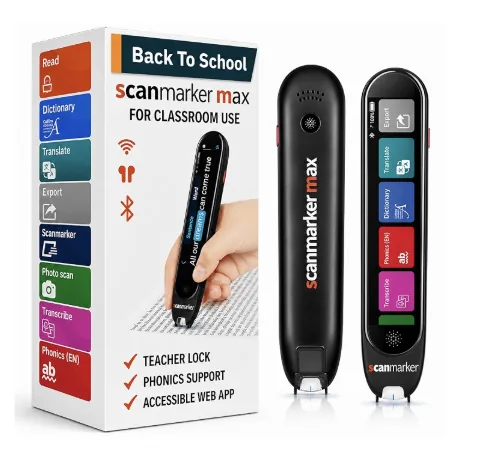
Among standalone reading pens, three models are genuinely built around dedicated read-aloud: Scanmarker Max, the Max Bundle, and Scanmarker PAL. These are the models worth comparing directly for a dyslexic reader.
The remaining models — Pro, Air, Reader, and USB — are connected devices built for different jobs: Pro and Air for OCR-heavy note-taking and document workflows, Reader for lighter phone-tethered read-aloud, and USB for budget desk scanning. They can still read text aloud, but none of them work independently of a paired phone, tablet, or computer, which is the feature that matters most for a reader who wants to keep going without stopping to find a device.
The three standalone models, compared
Every specification below is verified from direct hardware benchmarks — nothing here is estimated.
| Model | Price | Offline languages | Exam-lock mode | Best for |
|---|---|---|---|---|
| Scanmarker Max | $299 | 30 languages | Yes | Touchscreen, offline TTS, and exam-lock in one device |
| Max Bundle | $319 | 30 languages | Yes | Max plus 200 phonics practice cards — the pick for early readers |
| Scanmarker PAL | $179 | English | No | Simple, durable, standalone read-aloud at the lowest price in the standalone tier |
- Price
- $299
- Offline languages
- 30 languages
- Exam-lock mode
- Yes
- Best for
- Touchscreen, offline TTS, and exam-lock in one device
- Price
- $319
- Offline languages
- 30 languages
- Exam-lock mode
- Yes
- Best for
- Max plus 200 phonics practice cards — the pick for early readers
- Price
- $179
- Offline languages
- English
- Exam-lock mode
- No
- Best for
- Simple, durable, standalone read-aloud at the lowest price in the standalone tier
1. Scanmarker Max — best all-around standalone pick
Max is the most capable standalone model: a touchscreen, offline text-to-speech in 30 languages, and exam-lock mode, which disables translation and dictionary features during testing so only read-aloud remains active where that configuration is permitted.
Trade-off: at $299, it is the most expensive model in the standalone tier, and its 30-language offline set is narrower than the 112-language OCR coverage on the connected models — that gap only matters if translation breadth is the priority, not read-aloud.
2. Max Bundle — best for early readers building phonics
The Max Bundle is Scanmarker Max plus 200 phonics practice cards, not a separate device. For a younger or early reader where phonics practice matters alongside read-aloud, the $20 premium over Max alone buys a complete system rather than a second purchase later.
Trade-off: if phonics cards are not needed, Max alone is functionally identical and $20 cheaper.
3. Scanmarker PAL — best lower-cost standalone option
PAL is the simplest standalone model: no touchscreen, no translation, English only — just a durable, no-setup reading pen. At $179 it is the lowest-priced way to get genuine standalone read-aloud in the lineup.
Trade-off: no exam-lock mode and no translation, so a buyer who specifically needs either of those should compare Max instead.
What about Pro, Air, Reader, and USB?
These four are worth naming so a reader searching for "best reading pen" does not end up with the wrong tool. Pro ($249) and Air ($169) are connected devices built around OCR and typing scanned text into a document — strong for note-taking, not built around independent read-aloud. Reader ($149) is a lighter connected read-aloud option for a buyer who always has a phone on hand and does not need standalone operation. USB ($79) is a wired, budget desk-scanning option with no standalone reading feature at all.
None of these four are wrong choices — they are just answering a different question than "which pen helps a dyslexic reader keep reading independently."
How to actually choose
If exam-lock mode or translation matters, or budget allows for the most capable standalone device: Scanmarker Max.
If phonics practice alongside read-aloud matters, especially for a younger reader: the Max Bundle.
If the priority is the lowest-cost way to get genuine standalone read-aloud, with no phone or translation needed: Scanmarker PAL.
If a phone or computer is already part of the workflow and standalone operation is not required: Pro, Air, or Reader are worth comparing on their own terms — see the full comparison table for specifics.