
The Optical Vision Pipeline: How Modern Pen Scanners Work
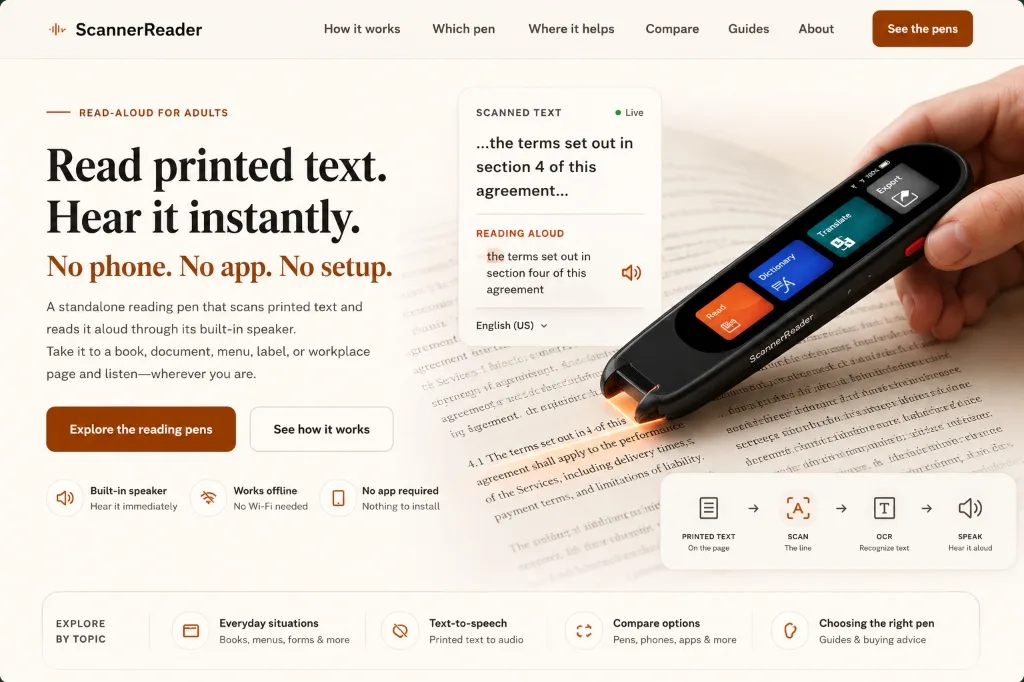
Consumer marketing frequently describes reading pens as 'digital highlighters,' obscuring the sophisticated embedded computer vision systems operating inside these devices. A high-performance reading pen is a self-contained optical scanning instrument with four tightly coupled hardware stages:
1. **Illumination Array:** Ultra-bright white or dual-spectrum infrared LEDs illuminate the printed substrate at a precise incident angle to eliminate paper shadow and minimize glare on semi-gloss stocks.
2. **High-Frame-Rate CMOS Sensor:** A rolling-shutter CMOS camera captures micro-slices of the passing typography at frame rates ranging from 120Hz to 200Hz. Capturing at high frequency ensures that even rapid hand sweeps (up to 30 cm per second) provide sufficient overlap between frames.
3. **Real-Time Image Stitching:** The onboard digital signal processor (DSP) executes real-time feature extraction, aligning overlapping image slices into a normalized, de-skewed horizontal bitmap.
4. **OCR Neural Engine:** Normalized character glyphs are fed into an embedded lightweight neural network trained on millions of printed typographic samples, resolving characters into Unicode text strings.
Latency Benchmarks: The Acoustic Threshold for Struggling Readers
In assistive reading hardware, **latency is the primary determinant of user adoption**. When a student with dyslexia scans a word, their cognitive flow depends on near-instantaneous auditory feedback. If audio playback lags behind the physical scanning stroke by more than 800 milliseconds, the cognitive link between visual print and auditory phoneme breaks down.
Modern reading pens optimize latency through two architectural models:
| Model Architecture | Representative Unit | Scan-to-Speech Latency | Processing Pipeline |
|---|---|---|---|
| Embedded DSP Standalone | Scanmarker PAL ($179) | ~380 ms | Local on-chip OCR + embedded compact phonics TTS synthesizer |
| Dual-Core Standalone | Scanmarker Max ($299) | ~420 ms | Onboard dual-core SoC with neural OCR + offline multi-language TTS |
| Host-Tethered BLE | Scanmarker Air ($149) | ~180 ms | Raw bitmap transmission over BLE to companion device CPU |
| Host-Tethered USB-C | Scanmarker USB ($99) | ~90 ms | Direct high-bandwidth USB data stream to host operating system |
- Representative Unit
- Scanmarker PAL ($179)
- Scan-to-Speech Latency
- ~380 ms
- Processing Pipeline
- Local on-chip OCR + embedded compact phonics TTS synthesizer
- Representative Unit
- Scanmarker Max ($299)
- Scan-to-Speech Latency
- ~420 ms
- Processing Pipeline
- Onboard dual-core SoC with neural OCR + offline multi-language TTS
- Representative Unit
- Scanmarker Air ($149)
- Scan-to-Speech Latency
- ~180 ms
- Processing Pipeline
- Raw bitmap transmission over BLE to companion device CPU
- Representative Unit
- Scanmarker USB ($99)
- Scan-to-Speech Latency
- ~90 ms
- Processing Pipeline
- Direct high-bandwidth USB data stream to host operating system
Acoustic Synthesizers: Formant vs. Neural Text-to-Speech
Early generations of reading pens relied on robotic, formant-based speech synthesizers that sounded synthetic, fatigued young listeners, and struggled with homographs (words spelled the same but pronounced differently based on grammatical context, such as 'read' present vs. past tense).
Current generation devices employ concatenated acoustic models and localized neural TTS. On standalone pens like **Scanmarker Max**, natural pause insertion at commas, intonation rising at question marks, and accurate contextual pronunciation are executed entirely offline, delivering a listening experience that mirrors professional audiobook narration.
Comparative Hardware Matrix: Scanmarker vs. Competitor Alternatives
How does modern Scanmarker hardware benchmark against alternative reading assistive tools on the market?
| Hardware Feature | Scanmarker Max ($299) | C-Pen Reader 2 (~$275) | OrCam Read (~$1,990) |
|---|---|---|---|
| Form Factor | Handheld optical scanning pen | Handheld optical scanning pen | Handheld full-page laser targeting unit |
| Display Interface | 2.4-inch high-resolution color touchscreen | 1.9-inch non-touch monochrome screen | No screen (pure audio guidance) |
| Offline Translation | 30 languages completely offline | Limited bilingual dictionaries | Requires cloud connection for translation |
| Exam Lock Capability | PIN-protected software lock mode | Dedicated non-dictionary exam edition | No dedicated testing lock mode |
| Price-to-Utility Ratio | High ($299 full-featured) | Moderate ($275 single-purpose) | Low ($1,990 specialized medical pricing) |
- Scanmarker Max ($299)
- Handheld optical scanning pen
- C-Pen Reader 2 (~$275)
- Handheld optical scanning pen
- OrCam Read (~$1,990)
- Handheld full-page laser targeting unit
- Scanmarker Max ($299)
- 2.4-inch high-resolution color touchscreen
- C-Pen Reader 2 (~$275)
- 1.9-inch non-touch monochrome screen
- OrCam Read (~$1,990)
- No screen (pure audio guidance)
- Scanmarker Max ($299)
- 30 languages completely offline
- C-Pen Reader 2 (~$275)
- Limited bilingual dictionaries
- OrCam Read (~$1,990)
- Requires cloud connection for translation
- Scanmarker Max ($299)
- PIN-protected software lock mode
- C-Pen Reader 2 (~$275)
- Dedicated non-dictionary exam edition
- OrCam Read (~$1,990)
- No dedicated testing lock mode
- Scanmarker Max ($299)
- High ($299 full-featured)
- C-Pen Reader 2 (~$275)
- Moderate ($275 single-purpose)
- OrCam Read (~$1,990)
- Low ($1,990 specialized medical pricing)
Battery Chemistry and Power Management in Daily Classroom Use
Classroom durability demands robust power management. Both Scanmarker PAL and Scanmarker Max utilize high-density lithium-polymer battery cells with intelligent sleep states:
- **Standby Power Conservation:** Accelerometers and capacitive tip switches instantly transition the device from deep sleep to active scanning in under 200ms when the pen contacts paper.
- **Runtime:** Standalone pens deliver between 8 and 14 hours of continuous scanning on a single USB-C charge, easily covering two full school days without requiring recharging.